Data-Safe Electronics Disposal in Dubai: Hard Drive Shredding, Storage Sanitization and Secure IT Asset Disposition
Disposing of old computers, enterprise servers, and storage drives requires verified data destruction. Here is how to safely sanitize and recycle IT assets in Dubai.
Standard operating system formatting or factory resets leave residual magnetic and NAND flash data easily recoverable with basic commercial software.
UAE Federal Decree-Law No. 45 on Personal Data Protection (PDPL) imposes heavy penalties for corporate data breaches originating from discarded electronics.
Physical hydraulic shearing, high-gauss degaussing, or industrial punch shredding provide irreversible physical proof of media destruction.
Reputable IT asset disposition (ITAD) providers issue tamper-evident serial-tracked Certificates of Destruction for corporate compliance audits.
What is data-safe electronics disposal in Dubai?
Data-safe electronics disposal combines certified cryptographic wiping or physical destruction of storage media (HDDs, SSDs, magnetic tapes, and flash chips) with environmental e-waste recycling. Storage drives are sanitized to international NIST SP 800-88 standards or physically pulverized before the remaining metal chassis and circuit boards are smelted for material recovery.
In a major international business hub like Dubai, hardware turnover is relentless. Financial institutions in DIFC, technology firms in Internet City, retail chains in Business Bay, and home offices across the city regularly decommission desktop computers, cloud servers, laptops, and network storage arrays. Safely disposing of these devices requires balancing environmental sustainability with non-negotiable data privacy.
Why a factory reset is not enough for retired hardware
Many users believe that clicking 'Format Drive' or initiating a factory reset completely erases stored files. In reality, standard operating system formatting merely removes directory file pointers, leaving the underlying raw data intact across magnetic sectors or flash blocks. Anyone equipped with free recovery software can reconstruct sensitive financial records, customer databases, personal passwords, and identification scans in minutes.
Solid-state drives (SSDs) and NVMe cards present an even greater sanitization challenge due to wear-leveling algorithms. Flash controllers distribute write cycles across reserve memory cells that software wipes cannot touch. Without cryptographic crypto-erasure commands or physical destruction, residual data remains embedded in the NAND chips.
Data sanitization methods: security level, media suitability, and compliance
Destruction Method
Applicable Media
Security Level & Outcome
NIST Clear (Multi-Pass Overwrite)
Functional magnetic HDDs intended for donation
Software sanitization; overwrites all addressable locations; drive reusable
NIST Purge (Cryptographic Erase)
Modern NVMe and SATA SSDs with hardware encryption
Sanitizes internal controller encryption keys; data rendered irreversibly unreadable
Electromagnetic Degaussing
Magnetic hard drives (HDDs) and backup tapes
Neutralizes magnetic field completely; damages read/write heads; drive rendered unusable
Physical Cross-Cut Shredding
All storage drives (HDDs, SSDs, smartphones, USBs)
High-torque blades crush drives into 10mm fragments; 100% irreversible destruction
Legal compliance: UAE Personal Data Protection Law (PDPL) & DIFC regulations
Data privacy in the UAE is governed by stringent federal legislation. UAE Federal Decree-Law No. 45 of 2021 regarding the Protection of Personal Data (PDPL) mandates that businesses implement technical and organizational measures to protect consumer data throughout its lifecycle, including disposal.
In free zones such as DIFC and ADGM, independent data protection commissioners impose statutory fines exceeding AED 1,000,000 for negligent data spillage. Allowing employee laptops or enterprise hard drives to slip into informal scrap markets constitutes a severe compliance violation. Corporate entities must demonstrate an unbroken chain of custody for all decommissioned IT assets.
Never hand storage media to informal junk scavengers
Unlicensed scrap collectors roaming residential neighborhoods will often dismantle computers purely for copper and aluminum resale, leaving loose, intact hard drives in unmonitored scrap yards where identity theft and corporate espionage risks are severe.
The physical destruction process: shearing, punching, and shredding
For organizations handling confidential client data, medical records, or proprietary IP, physical destruction offers absolute peace of mind. Certified IT asset disposition facilities employ heavy hydraulic punchers that bend and fracture magnetic platters with 5,000 psi of concentrated force, warping the spindle and shattering the glass-ceramic substrate.
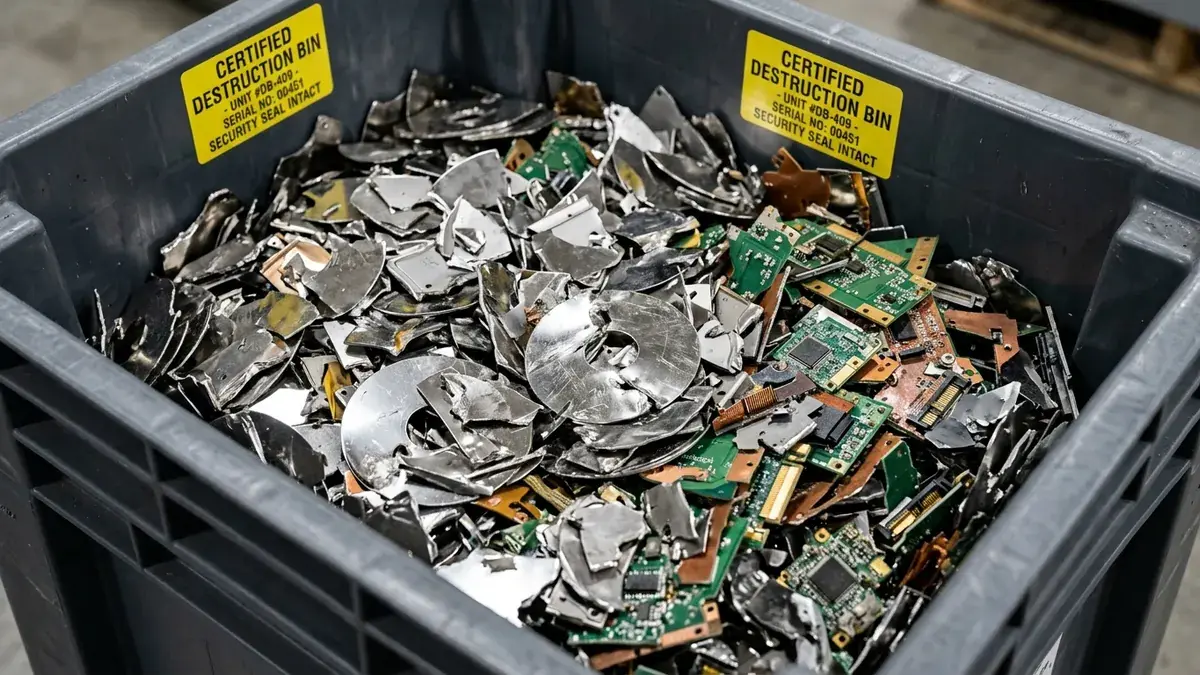
For maximum security, industrial cross-cut shredders slice through solid steel cases, printed circuit boards, and memory chips, reducing whole hard drives to unrecognizable metal confetti. The resulting scrap is sorted via eddy current separators, directing copper, aluminum, and precious metal pins to certified UAE refining smelters.
Mechanical shearing and punching guarantee that magnetic and solid-state data cannot be recovered before metals enter the recycling furnace.
Obtaining a Certificate of Destruction (CoD) for business handovers
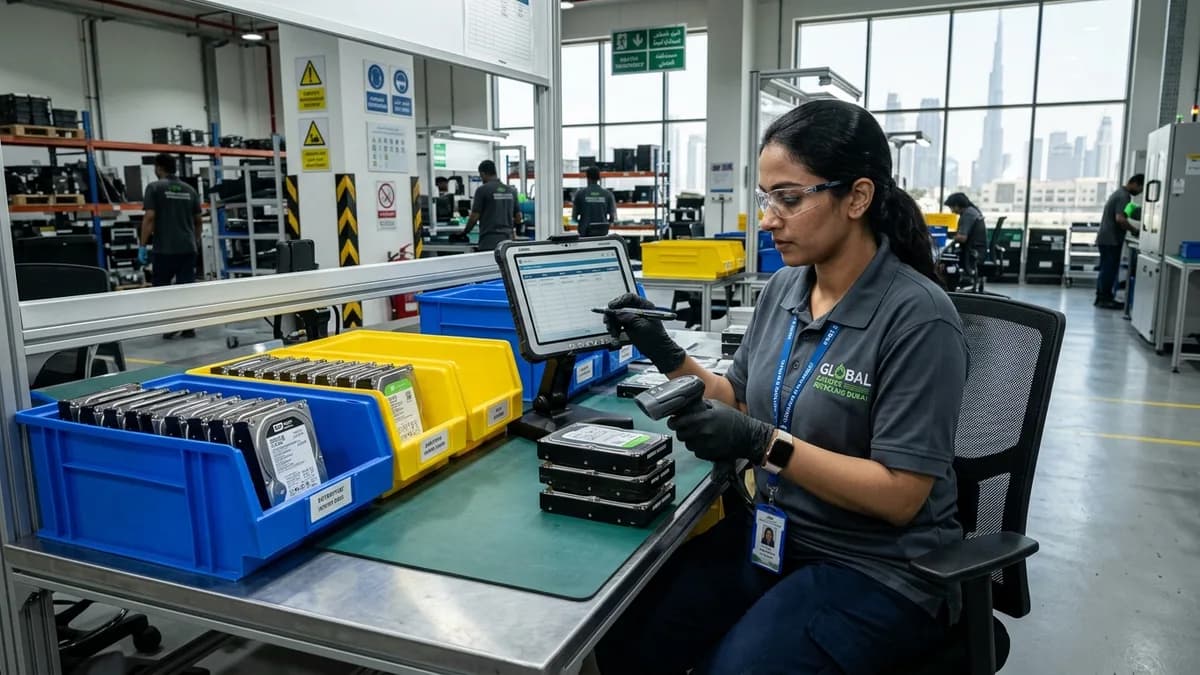
Corporate IT compliance requires definitive proof that media was destroyed in accordance with international standards. Professional destruction services record drive serial numbers via optical barcode scanning prior to feeding units into the shredder.
Upon completion, clients receive a tamper-evident Certificate of Destruction (CoD) itemizing every processed asset, date, methodology, and the witnessing technician's signature. This certificate serves as legally defensible documentation during internal audits, ISO 27001 verifications, and external regulatory reviews.
Can solid-state drives (SSDs) be wiped with magnets?
No. Degaussers only work on magnetic media like traditional rotating platter hard drives and magnetic tapes; SSDs store data electronically in NAND flash chips and require cryptographic erase or physical cross-cut shredding.
What happens to the metal and circuit boards after shredding?
After storage media is mechanically destroyed, remaining copper, aluminum, steel, and printed circuit boards are separated and sent to certified UAE e-waste smelters for metallurgical refining.
Can Dubai Junk Collection remove office computers with drives already pulled?
Yes. Many corporate IT departments prefer to remove and destroy drives in-house; we collect the remaining server chassis, monitors, cabling, and peripherals for licensed zero-landfill e-waste processing.
Planning a clearance in Dubai?
Send photos of what you need cleared on WhatsApp. Our team provides an instant, fixed upfront rate and handles elevator bookings and gate security smoothly.
Specialists in residential and commercial clearances across Dubai since 2016. Committed to safe property handovers, compliant electronic waste disposal, and municipal green waste diversion.
 Ask a Question