How to Dispose of Office Cubicles in Dubai: Power Isolation, Panels and Lift Access
Cubicles are building systems, not loose desks. Audit power and data, label reusable modules, dismantle in sequence and plan after-hours loading without disrupting occupied floors.
Have facilities or a qualified contractor isolate any power and data feeds before the first panel is released.
Photograph, label and count panels, connectors, worktops and hardware before dismantling to preserve reuse value.
Agree freight-lift, loading-bay, parking and after-hours rules with building management before scheduling the crew.
How do you dispose of office cubicles in Dubai?
To dispose of office cubicles in Dubai, first audit ownership, power, data and reusable modules. Have qualified contractors isolate connected services, then label and dismantle panels in the manufacturer's sequence. Protect occupied routes, reserve the freight lift and loading bay, and separate steel, aluminium, timber board, cabling and reusable components.
A cubicle is not simply a desk with screens. Its panels may stabilize worktops, carry power sockets and conceal network cables. Removing the wrong connector first can drop a return top, damage a live feed or turn a reusable modular system into mixed debris.
Audit ownership, records and services before dismantling
Confirm whether the system belongs to the tenant, landlord or fit-out contractor, and compare it with the lease and reinstatement scope. Record the maker, panel sizes, finishes, workstation layout and damaged modules. Photograph cable paths and floor-box positions before equipment is unplugged.
IT should remove computers, desk phones and data-bearing devices, while facilities identifies circuits, floor boxes and any under-desk power modules. Fixed electrical work requires the appropriate qualified contractor. Our office relocation clearance plan covers sequencing equipment, records and furniture around a live workday.
Treat panel sockets as live until proved otherwise
Turning off a workstation power strip does not isolate a circuit feeding modular panels. Facilities or a qualified electrical contractor must identify, isolate and make the connection safe before dismantling.
Preserve reuse value with a labelled dismantling sequence
Create a bay-by-bay plan and mark matching panels, worktops, brackets and legs with removable labels. Bag proprietary clips and fasteners by workstation. Remove screens, cable trays and return tops in the maker's sequence while temporary supports hold any surface that depends on the panels.
Keep fabric panels dry and upright; do not fold or stack weight on them. Protect laminate edges and wrap glass divider panels individually. Complete one test bay first, which reveals hidden fixings and produces an accurate time estimate before the main after-hours clearance begins.
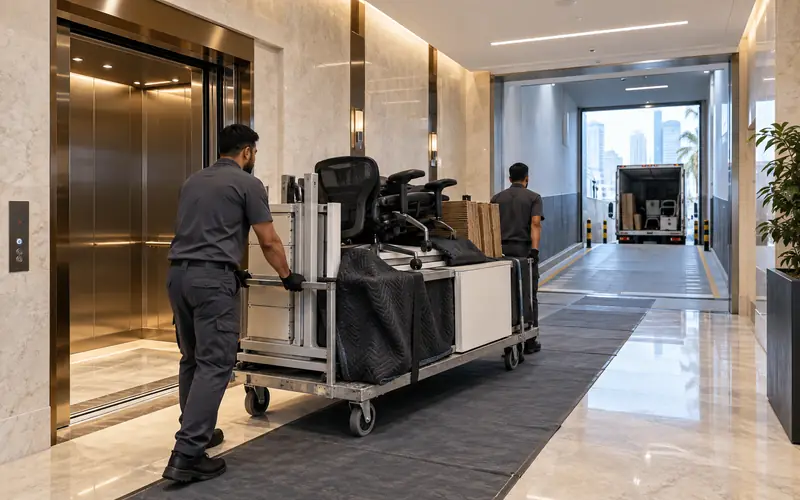
A labelled, protected route keeps reusable office modules organized and reduces disruption to occupied floors.
Plan a building-approved route and work window
Send management the contractor list, method statement, insurance documents and vehicle details they request. Reserve the freight lift and loading bay, confirm parking-height limits, and protect floors and lift walls. DIFC and Business Bay offices often share service areas, so an unbooked truck can lose the planned window.
Separate noisy dismantling from quiet occupied periods and maintain clear fire exits throughout. Use closed carts for fasteners and short components, and never lean tall panels against a corridor wall. A floor marshal should control lift movements so staff and visitors do not enter the work zone.
Choose reuse, resale or material recovery by module
Complete systems with a known maker, consistent sizes and intact connectors are easier to resell than mixed loose panels. Offer an inventory, layout drawing, photographs and a collection deadline. Damaged fabric, cut cable looms or missing proprietary hardware should be disclosed rather than hidden in a bulk lot.
When reuse is not possible, separate steel frames, aluminium trims, recoverable cable and clean worktops according to the receiving facility's rules. Our office junk removal service can coordinate phased loading, while the workplace decluttering guide helps decide what should leave before dismantling starts.
Can an office removal crew disconnect powered cubicles?
Only if the agreed crew includes an appropriately qualified contractor for the electrical scope. Tell the provider whether feeds are plug-connected, hard-wired or supplied through floor boxes, and obtain facilities approval before work.
Are used cubicle panels worth reselling in Dubai?
They can be when the system is complete, clean and identifiable. Value falls sharply when connectors are missing, panel sizes are mixed or worktops have been cut. A labelled inventory and layout drawing improve the chance of reuse.
How should confidential material be handled during cubicle removal?
Clear every pedestal, overhead bin and cable tray before contractors start. Place confidential paper in the organization's approved locked shredding stream and send data-bearing devices through the IT asset process.
Do office cubicles need a freight-lift booking?
Most managed commercial towers require one, along with a loading-bay slot and contractor documentation. Confirm the building's rules because passenger lifts and public lobbies may be prohibited for fit-out materials.
Can cubicle panels be broken up to save truck space?
Not if reuse is possible. Destructive handling mixes fabric, foam, board and metal and creates sharp edges. Dismantle at connectors first, then let the receiving route decide which irreparable modules need material separation.
Planning a clearance in Dubai?
Send photos of what you need cleared on WhatsApp. Our team provides an instant, fixed upfront rate and handles elevator bookings and gate security smoothly.
Specialists in residential and commercial clearances across Dubai since 2016. Committed to safe property handovers, compliant electronic waste disposal, and municipal green waste diversion.
 Ask a Question