How to Dispose of an Old Safe in Dubai: Lost Codes, Anchor Bolts and Heavy Lifts
A safe is small, dense and usually bolted down. Open it, unbolt it properly, and tell whoever moves it exactly how heavy it is and how it will get out.
Empty the safe and find its key or code before anything else; a locked safe complicates every route.
For a lost code, use the manufacturer or a locksmith with proof of ownership, not an angle grinder.
Most safes are bolted down; remove anchors cleanly and plan who fills the holes before handover.
Give the collector the safe's weight, the floor and the route so they bring the right equipment.
How do you dispose of a safe in Dubai?
Empty it, find the key or code, and check whether it is bolted to the floor or wall. Have anchor bolts removed by someone who knows what is under the slab, then tell the collector its weight and the route. Sell or pass on working safes with their keys; scrap failed ones as metal.
The real difficulty in working out how to dispose of a safe in Dubai is weight in a small footprint. A safe the size of a bedside cabinet can be heavier than a sofa, and all of that weight sits on four small feet. It will mark a marble floor, overload a cheap trolley and injure anyone who tries to walk it down stairs.
Open it first and check what is inside
Empty every compartment, including hidden drawers and the back of shelves, and keep documents, jewellery and spare keys with you rather than in a box for the movers. For electronic safes, fit fresh batteries before you test the keypad; many apparently dead safes are simply out of power.
If the code or key is lost, contact the manufacturer or a locksmith. Expect to show proof that the safe is yours, such as a receipt, tenancy contract or property documents, before anyone opens it. Do not attack a locked safe with a grinder or drill at home. Sparks, hot steel and fire-resistant lining make it a dangerous job, and it can destroy whatever is still inside.
A safe left by a previous occupant
If a safe was already in the property when you moved in, tell the landlord or agent before it is opened or removed. It may be part of the property or still hold someone else's belongings.
Identify the safe and how it is fixed
Look for a label inside the door or on the back with the model number; the manufacturer's specification will usually give the weight. Then check how it is held in place. Small wardrobe and room safes are often bolted through the back or base into the wall or floor. Larger security safes are anchored into the concrete slab.
Remove anchors with the correct socket rather than levering the safe until something gives. Expect bolt holes in the floor or wall afterwards. In a rental, agree with the landlord who fills them before handover. A safe set into a wall or floor is part of the building structure and should be left to a contractor, or left in place with the owner's agreement.
Common household safes and what each needs
Safe type
Typical issue
Before collection
Small electronic room or wardrobe safe
Keypad batteries and bolts through the back
Fit new batteries, open it and remove the fixing bolts
Fire-resistant document safe
Heavy for its size because of insulating fill
Empty it and confirm the weight from the model label
Floor-anchored security safe
Bolted into the concrete slab
Unbolt it, protect the floor and plan the route
Wall or floor-set safe
Built into the structure
Leave to a contractor or leave in place with the owner's consent
Plan the lift before anyone touches it
Send the collector the weight, dimensions, floor level and photographs of the route: steps, door thresholds, the lift and any tight turns. Check the rated load on the lift's capacity plate, and book the service lift rather than the passenger lift. Lay boards or thick runners over marble and timber floors so the safe's feet and the trolley wheels cannot dent them.
A safe should travel upright on a rated appliance trolley or stair-climbing trolley, strapped in place, with its door closed and secured. Close and lock it only if the next owner will have the code; otherwise tape or strap the door shut. Never walk a heavy safe down stairs by hand or slide it down a staircase on a blanket.
Do not tip a safe to get it through a door
Tilting a heavy safe moves its weight quickly and unpredictably. If it will not pass upright, stop and let a crew with the right equipment plan the move.
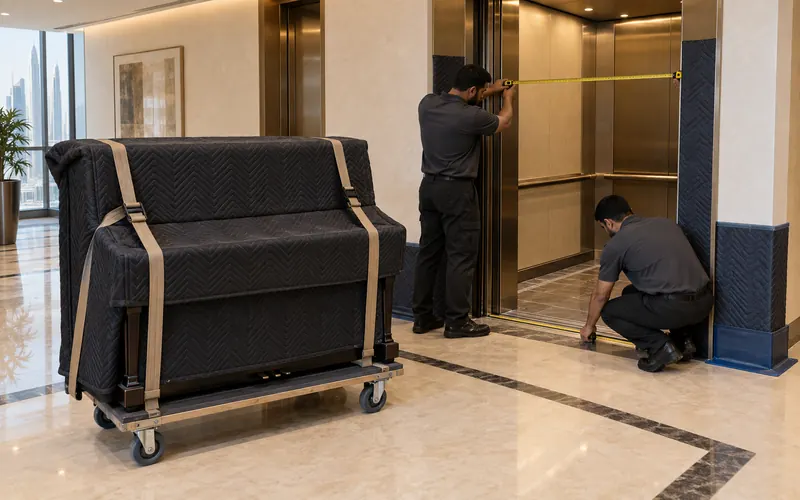
Measuring the lift and checking its rated load before collection day decides whether a heavy item can use it at all.
Resell it or recycle the metal
Working safes with keys, codes and a manual sell reasonably well, particularly small fire-resistant and electronic models. State the weight and whether the buyer must collect it themselves; it filters out people who arrive with a hatchback.
A safe that no longer locks properly, or is too damaged to sell, is mostly steel and belongs in metal recycling. Fire-resistant safes have an insulating fill between their steel skins, so scrap buyers may value them below plain steel. If it is part of a wider clear-out, adding it to the same collection as other heavy items is often the simplest route.
Yes, as long as you own it and it is empty or you accept that the contents go with it. Many collectors will take a locked safe for metal recycling. If anything might still be inside, have it opened first by the manufacturer or a locksmith, with proof of ownership, before it leaves the property.
Who fills the anchor holes after a safe is removed?
In a rental, agree it with the landlord before removal; tenants are normally expected to return the floor and walls in their original condition. Small holes in tile, plaster or concrete are a routine handyman job, but on marble or timber floors it is worth using someone experienced with that finish.
Can I take a small safe to the municipality myself?
A small, light safe can be treated like other household metal or bulky items, so check Dubai Municipality's current bulky-waste options or ask the building about its collection arrangements. Lift it with your legs, keep it close to your body and use a trolley; small safes are deceptively heavy.
Planning a clearance in Dubai?
Send photos of what you need cleared on WhatsApp. Our team provides an instant, fixed upfront rate and handles elevator bookings and gate security smoothly.
Specialists in residential and commercial clearances across Dubai since 2016. Committed to safe property handovers, compliant electronic waste disposal, and municipal green waste diversion.
 Ask a Question