How to Dispose of a Reception Desk in Dubai: Counters, Cables and Access
Confirm ownership, isolate reception technology, record the desk's modules and protect heavy counters before the lobby's public route opens for removal.
Check the fit-out inventory before removal because the desk, signage, stone counter and floor connections may have different owners.
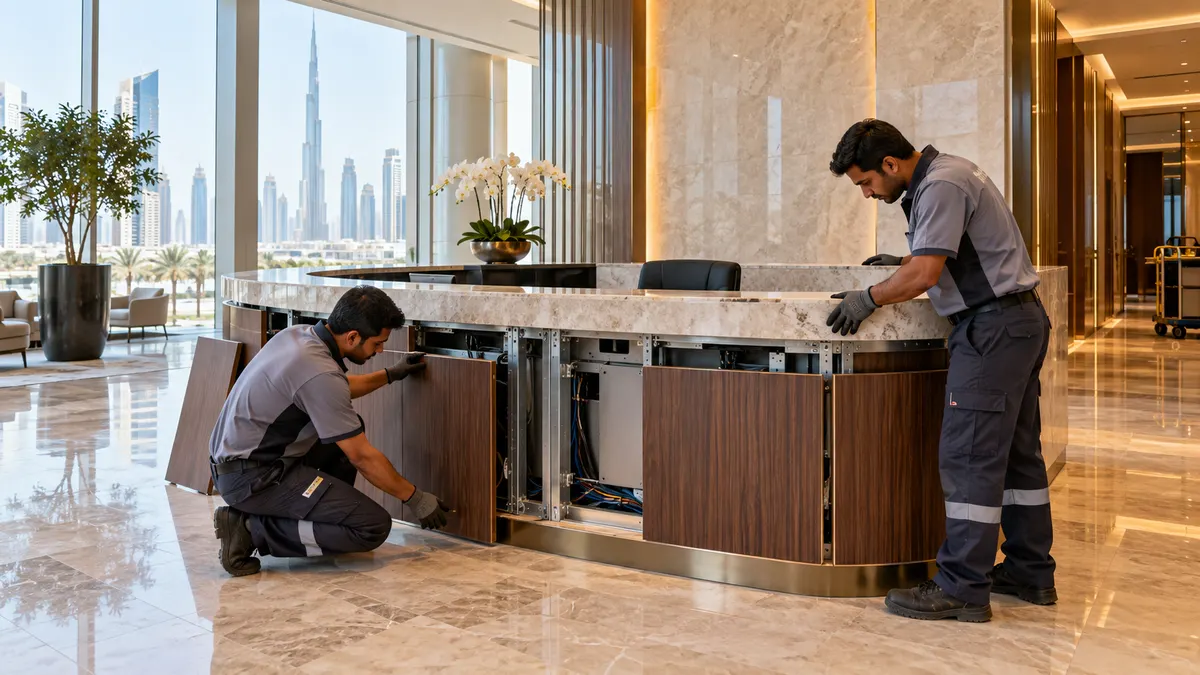
Facilities should isolate power and data before panels open; record every module, bracket and cable route before dismantling.
Measure protected counter sections against lobby doors, service lifts and loading access, then schedule work outside public reception hours.
How do you dispose of a reception desk in Dubai?
To dispose of a reception desk in Dubai, confirm who owns the joinery, stone, signage and equipment. Have facilities isolate power and data, photograph each module, support heavy counters before releasing panels, retain matched fixings, protect the lobby route, and book an approved service-lift and loading-bay window for reuse or collection.
A reception station is often part furniture and part fit-out. Curved shells hide linked brackets, transaction counters can be stone or solid surface, and floor boxes may feed phones, access control, screens and panic buttons. Treating it like a freestanding desk risks damaging both the station and the building services beneath it.
Close the ownership, security and building-services checks
Start with the asset register, lease inventory and fit-out drawings. Confirm whether the tenant owns the desk while the landlord owns its floor box, wall cladding or fixed signage. Remove visitor logs, access cards, spare keys and printed records. Ask IT or security to sign off any badge printer, CCTV display, duress button or access-control device before it leaves the counter.
A competent facilities or electrical person should isolate fixed power and identify data or security cables. Do not cut a lead because it disappears behind a modesty panel. Photograph connections, label only after isolation and agree who will blank floor boxes, patch anchors and make good the wall or floor before the tenancy inspection.
Keep security systems in their own workstream
Reception desks can conceal access-control and emergency devices as well as ordinary power. The clearance crew should only handle equipment that IT, security and facilities have identified, isolated and released.
Map the modules before the first counter comes off
Photograph the desk from the lobby, staff side and underneath, then number connected sections from one end. Remove drawers, loose shelves and cable covers first. Support stone, glass or solid-surface counters on padded trestles before releasing their brackets; a long counter can crack under its own weight once the shell stops supporting it.
Bag fixings by joint and keep proprietary clips, levelling feet and cable grommets with the matching panel. Protect finished faces and corners rather than taping directly onto veneer or stone. Haworth's reception-station documentation shows why the sequence matters: desk tops, return tops, walls and counter tops are distinct components, not one object to drag through a doorway.
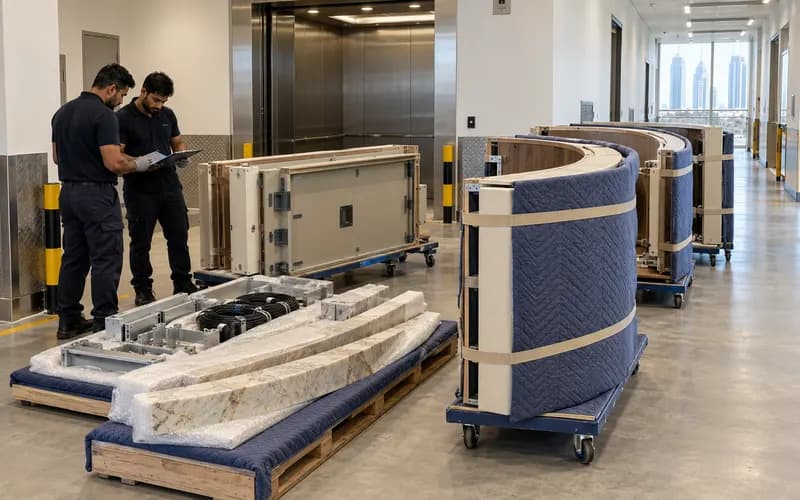
Record the module order, protect every counter edge and keep fittings with their original sections before the loading slot begins.
Plan a route that does not turn the lobby into a worksite
Measure the largest protected counter section, not just the assembled footprint. Check entrance gates, corridor turns, lift doors, car height and loading-dock clearance. Agree hoarding, floor protection, noise limits and contractor access with building management. In an occupied tower, dismantling normally belongs in an approved after-hours window so visitors never cross a tool or trolley route.
A complete modular station with sound surfaces and all hardware may suit another office; bespoke curved sections and damaged joinery are harder to reuse and should be separated by material where practical. Our office junk removal service can coordinate the cleared route in districts such as DIFC. Related guides cover office desk disposal, cubicle removal and conference-table dismantling.
Can a reception desk be removed without dismantling it?
Only a small freestanding station may travel intact after the full route and weight are checked. Modular or fitted desks should normally be recorded and separated in their designed sequence. Long counters can flex, curved shells can rack and an assembled unit may conceal anchors or building connections.
Who disconnects the power and access-control cables?
Facilities, IT, security or their appointed contractors should identify, isolate and release the relevant systems. A clearance crew can remove already-safe modular equipment, but it should not cut unknown cables, open live floor boxes or decide whether a security device belongs to the tenant or landlord.
Can a stone reception counter be reused?
It can be, provided it is intact, supported correctly and fits a new layout. Record its exact dimensions, cut-outs and bracket positions. Engineered or natural stone is heavy and vulnerable at narrow sections, so use edge protection and suitable handling equipment rather than carrying it like a timber panel.
What photos help quote reception-desk removal?
Send front, staff-side and underside views, overall dimensions, counter material and the number of joined modules. Include floor boxes, wall anchors, the lobby route, service lift and loading bay. State the approved work hours and whether signage, electrical isolation or reinstatement is handled separately.
Planning a clearance in Dubai?
Send photos of what you need cleared on WhatsApp. Our team provides an instant, fixed upfront rate and handles elevator bookings and gate security smoothly.
Specialists in residential and commercial clearances across Dubai since 2016. Committed to safe property handovers, compliant electronic waste disposal, and municipal green waste diversion.
 Ask a Question